Velkommen

Velkommen til Prosjekt gammel havseiler. En weblogg om havseileren Onkel Blå (tidligere Blues)- en IW 31 fra 1971. Bloggen er i første rekke for egen dokumentasjon, men hvis andre har nytte og glede av innholdet er det hyggelig. Legg gjerne igjen en hilsen i gjesteboken eller legg igjen kommentarer under innleggene.

Mottoet for Prosjekt gammel havseiler er todelt: Langsomt, men godt. Mottoet er dekkende for hvordan båtlivet skal utfolde seg. Nøkkelord her er sakte tid og naturopplevelser. For seilingens del ligger det dog et ønske om å gjøre skam på første del gjennom å leve opp til andre del.

For den som ønsker å vite mer om IW 31 finnes det en samling linker i høyre marg. Still gjerne spørsmål i det nye IW 31 Forum.

Viser innlegg med etiketten Historikk. Vis alle innlegg

torsdag 5. februar 2009

Hot IW 31

Onkel Blås IOR målebrev fra 1974 er havnet i retro-kategorien på blur.se. En hot IW med høy rigg og dyp smal kjøl - og vinner av Gotland Runt i 1973 - blir nevnt i kommentarene . Det er antakelig denne:

onsdag 28. januar 2009

Fra arkivet: IOR-målebrev anno 1974

Her er IOR-målebrevet til OR N-318 Blues anno 1974. Jeg skulle gjerne ha dekryptert måledataene, men har ennå ikke lykkes med å finne en kodenøkkel for de ulike forkortelsene.


Lagt til: Anders (se kommentar) har sendt meg en oversikt over de ulike parametrene. Tusen takk!

torsdag 15. januar 2009

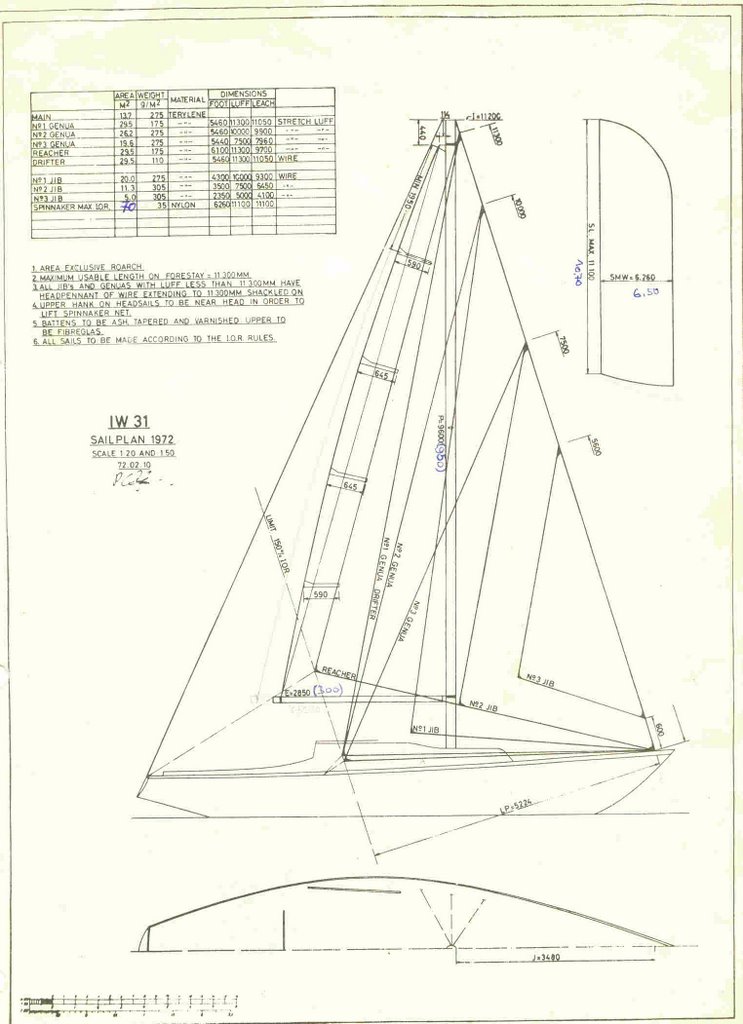
IW 31 - to ulike seilplaner

I arkivet fant jeg to ulike seilplaner for IW 31. 'Bodensee'-utgaven er litt høyere og er tegnet med en lettvinds 'ghoster' samt flere typer spinnaker stagseil. De siste finner man vel på historiens skraphaug sammen med blooperen....

fredag 15. august 2008

Rod Stephens og S&S


Sparkman & Stephens har lagt ut en uredigert og uferdig utgave av Rod Stephens bok 'Rod on Sailing, Lessons from the Sea' , hvor han deler sine erfaringer fra et langt liv som S&S 'practical man', den som sørget for at S&S-båter ble skikkelig bygget, rigget, utstyrt og seilt. Boken er desverre uten illustrasjoner, men mye kan finnes igjen i Sparkman&Stephens type plans. En klassiker fra Rod Stephens hånd er f.eks. Dorade-ventilen som ble designet til båten med samme navn. Les mer om Dorade.


Sakset fra boken:
"I heard a nice story a while ago and it might even be true. Two young fellows were walking
down a marina dock in Seattle and they saw our former old Dorade tied up
there. One of the
men said to the other, “Why do you suppose anyone would name his
boat after a ventilator”?
Well, that made me laugh, but it also made me feel good, because ventilation issomething that
Olin and I have always felt very strongly about in our designs. And if the Dorade ventilator
has become a basic part of sailors’ language today, then that’s fine.
"


"Way back in the early 30s, when Dorade was launched, we first tackled the
problem by making up four special ventilators with four-inch diameter necks and eightinch
cowls, about three, which were two and a half feet high, that screwed directly into
the deck in a waterproof deck plate. The cowls were on joints so they could be turned
away from the wind when the spray was flying. You couldn’t buy them that way, so we
had them manufactured."

"The trouble is that all these elements of the ventilator have to be designed
correctly for the idea to work right. The cowl area has to be four times that of the
standpipe - that is, twice the diameter - or else it won’t collect enough air. The box has to
be at least six inches tall or the downtake pipe can’t stick up far enough above the deck to
prevent water sloshing down it into the cabin; and the box has to be big enough so that
there is enough volume for the air and water to get separated inside it. There has to be
one good-sized scupper - at least one inch square - on each side of the after face of the
box, so the water can get out whichever way the boat is heeling, but so that a minimum
amount will get in when a sea comes aboard.

So these are the basics for good ventilation: boxes that are big enough and high
enough; vents that are tall enough and cowls that are big enough; scuppers on the after
side of the boxes."

søndag 13. april 2008

Olin Stephens 100 år


Jeg burde tatt meg tid til å skrubbe dekket og polere messingen før jeg flyttet Onkel Blå til Storsand, for i dag fyller Olin Stephens 100 år. Gratulerer!

ISAF Hall of Fame
Olin Stephens (dolphin24.org)
Olin Stephens 100 years old - a few designs (Sail World)
NYYC Profile of Olin Stephens

tirsdag 6. mars 2007

Hva pressen skrev...

Palstek:

Båtnytt (1977):


Båtnytt 1999:

mandag 5. februar 2007

Slik skal det seiles - noen bilder for å lindre vinterkløe


Et knippe lånte, stjålne og lett retusjerte bilder fra 'forna dar'.
Den gangen IW31 var en skarp cruiser/racer.


Blues - nå Onkel Blå - på tur med forrige eier.
Flott driv med ungdommen til rors. Slik skal det seiles!
(Bilde fra salgsannonsen på finn.no)


Vi skal nok prøve spinnakeren (70 kvm ) til sommeren,
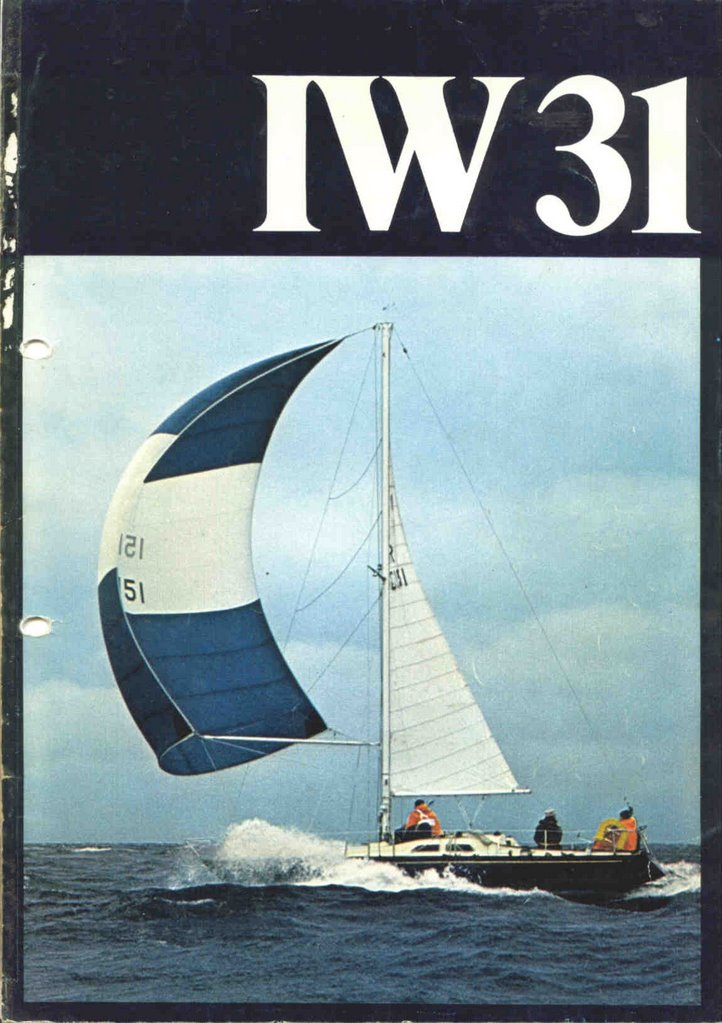
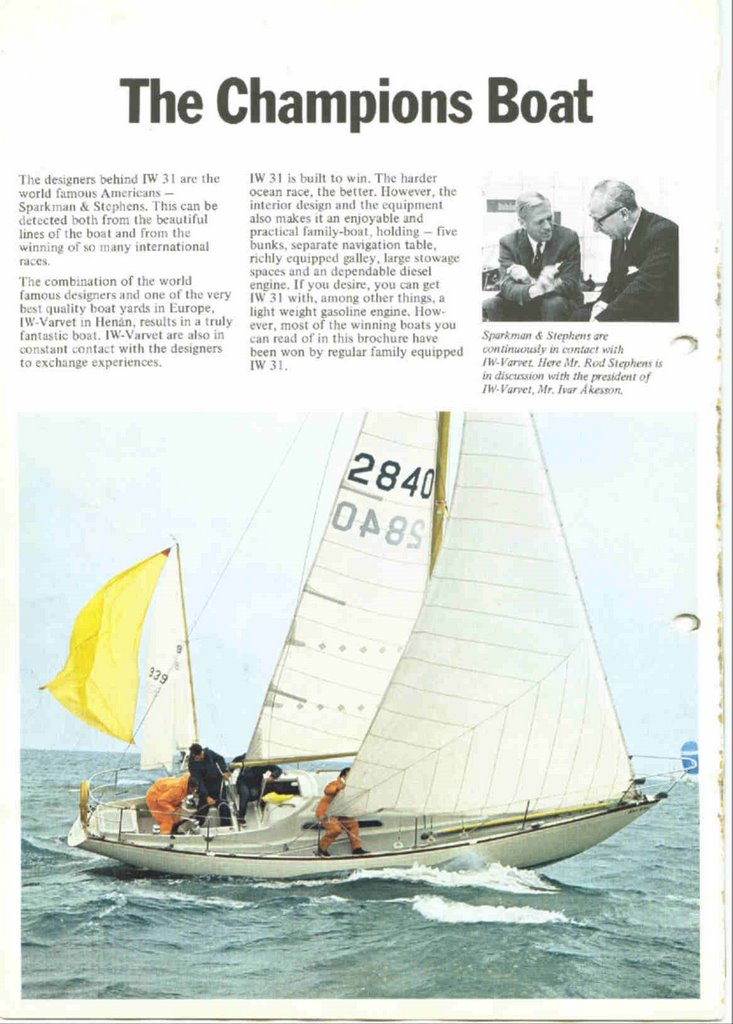
men får vel begynne med en lett bris først... (bilde fra salgsbrosjyren)


På kryss....(fra Båtnytt)


... og tvers (bilde fra brosjyre)

Akinom i fint driv

søndag 19. november 2006

Designet av Sparkman & Stephens

Seilplan - S&S design nr. 1899

IW 31 er Sparkman &Stephens design nr. 1899 datert 1968. S&S var verdens fremste båtkonstruktører i store deler av det 20. århundre. Grunnleggeren av Nautor, Pekka Koskenkyla, beskriver det slik:

The most important factor for this initial success was not so much my honest looking face or the fantastic workforce we had, because we had nothing to show. It was the name and reputation of Sparkman&Stephens. It is difficult to understand now how superior in reputation they were compared to other yacht designers. There was only one best choice then. The name and reputation of S&S was built on the winning boats of their design in all ocean racing from the America's Cup, One Ton Cup, Admirals Cup, Cowes week etc. Most of the winners in these races were designed by S&S.[...]

Rod and Olin Stephens were a good team. Olin was the scientist, who rarely traveled from the office and his drawing board. Rod was the opposite. He was the practical man, who liked to travel and visit the yards that were building S&S designed boats around the world. He would go out with cus-tomers on sea trials. In short he would help the yard to build a high quality boat and he would help the client to sail it well. His expenses were very reasonable. I remember him charging $100 per day and part of the traveling expenses, which were reasonable, because when he came to Europe he could maybe see ten different individuals or companies, so each one paid only 10 per cent of his expenses. Rod was very much a hands on person. At the yard he wasted only little time in the office. He was crawling all over the boats looking at each detail with his yellow note pad. He would take first his notes from previous visit and like a schoolmaster make sure that the previous points were rectified and if not they would be included in the new list. His work for us was absolutely essential. Because of his long experience in both sailing and building he knew more than any other living soul about sailing boats and how to build them right. Especially in our case we could not have been able to obtain the high quality of which SWANs have always been known without his keen interest and frequent visits. Typical of him was that, when a boat was launched and the owner asked him to participate in the sea trials with the builder and often sailmaker present, he would want to start at the crack of dawn. This was usually hard for the owner, because he would have celebrated typically the night before with champagne and maybe some stronger liquids, but Rod did not care, because he went to the bed at 9 PM and only drank milk. Early next morning he would have himself hoisted at the top of the mast checking all the rigging and attachments, then down to the spreaders etc. The owner who was anxious to go sailing would impatiently wait for hours with his crew. At lunch time Rod would only have a sandwich and a glass of milk while the owner would have a big meal in the restaurant with his crew to kill boredom and time. It was a long time before Rod was down to keel bolts and the builder's rep., often myself, had to be with him, because he wanted to make sure that I understood what he meant with his list of comments in his yellow note pad. The sun would be on its way down before he was ready to do what everybody had been waiting for, i.e. cast off and hoist the sails. It would, however, not be a pleasant cruise, because he made every-body work hard by constant sail changes. All the sails had to be tested at different angles of wind. All the deck fittings and their right positions with each sail verified. Another few sheets of notes were written and if a representative of the sail maker was present the builder's rep. could have the heat turned off for a few moments. These sea trials were always a full day of hard work, but well worth of it, because only few potential problems went without notice. The work that Rod did was as important as the design, because the SWANs rarely had technical problems, much less so than many other boats. Obviously if something on the boat breaks down before the finish of the race it can not win, no matter how good the design and crew is. Rod's work helped our reputation as a builder of strong boats that win races. No other design office has had such a team. Olin would design and Rod would make sure it was built right and then even test it afterwards rather than just make the drawings and leave the rest to the builder. It was our luck that we had them rather than some other designer.
(Kilde: www.classicswan.org)


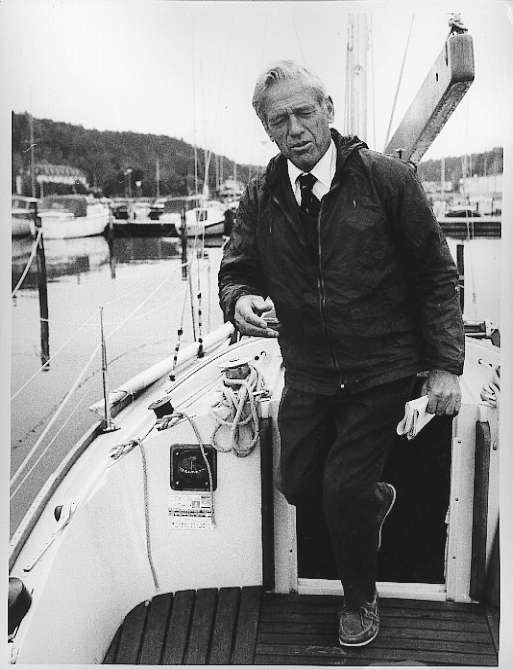
Rod Stephens inspiserer en IW 31


Forskjellige innredningsløsninger


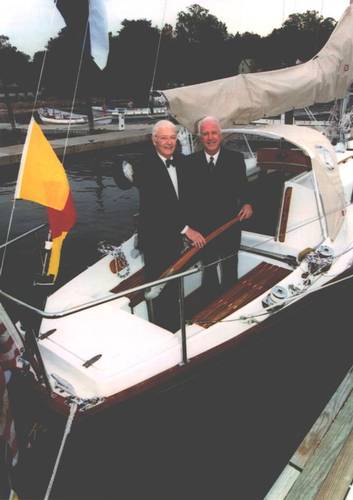
Olin Stephens ombord i en nyrestaurert IW 31


Olin Stephens er fortsatt aktiv i en alder av 90+ år.
Her fra et S&S-treff i Finland i 2005.

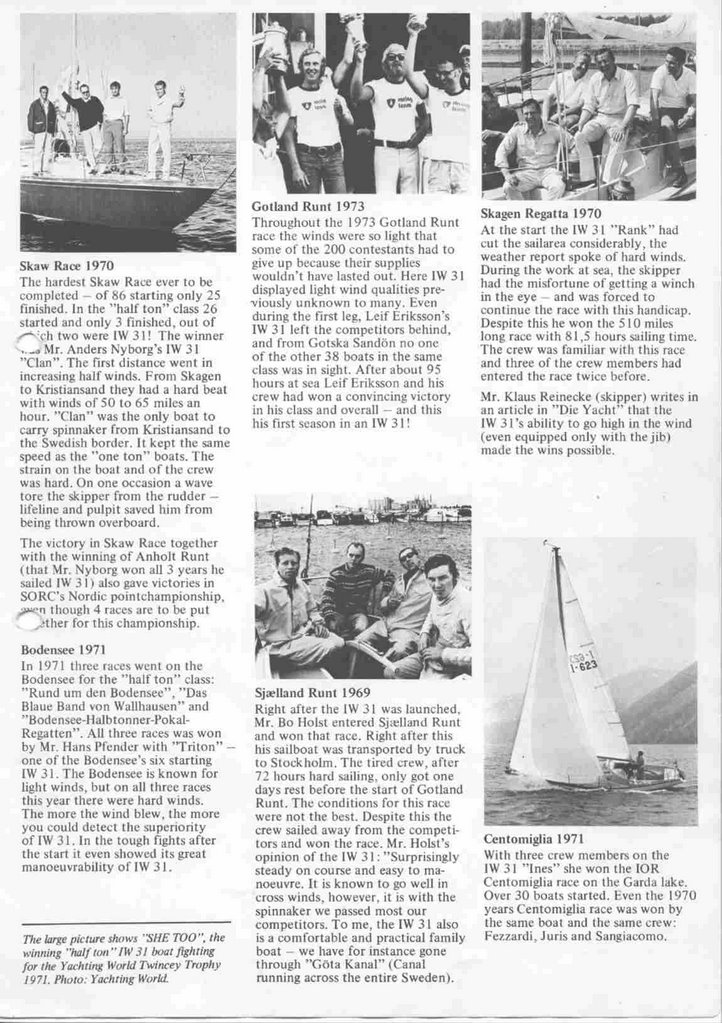
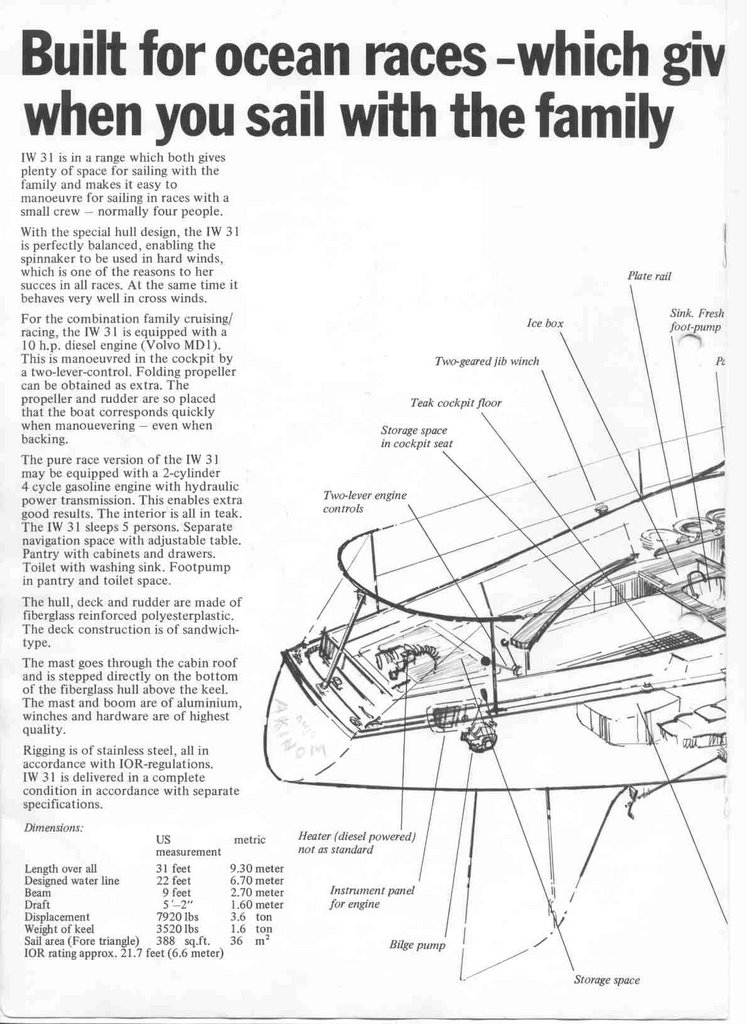
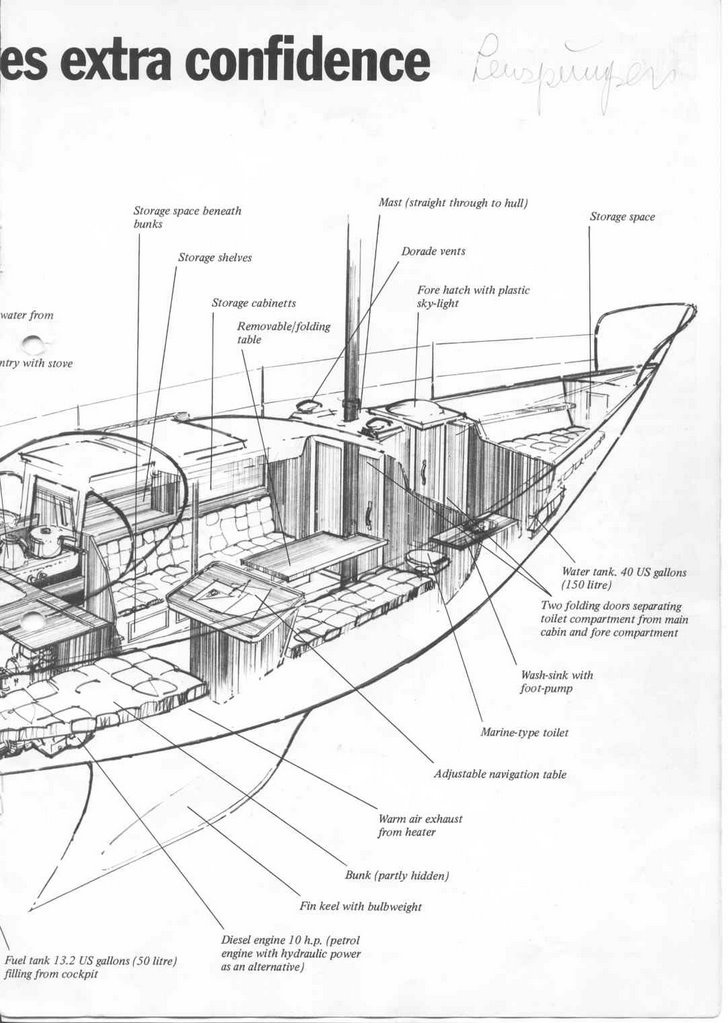
Brosjyre for IW 31

Brosjyre fra IW Varvet.